
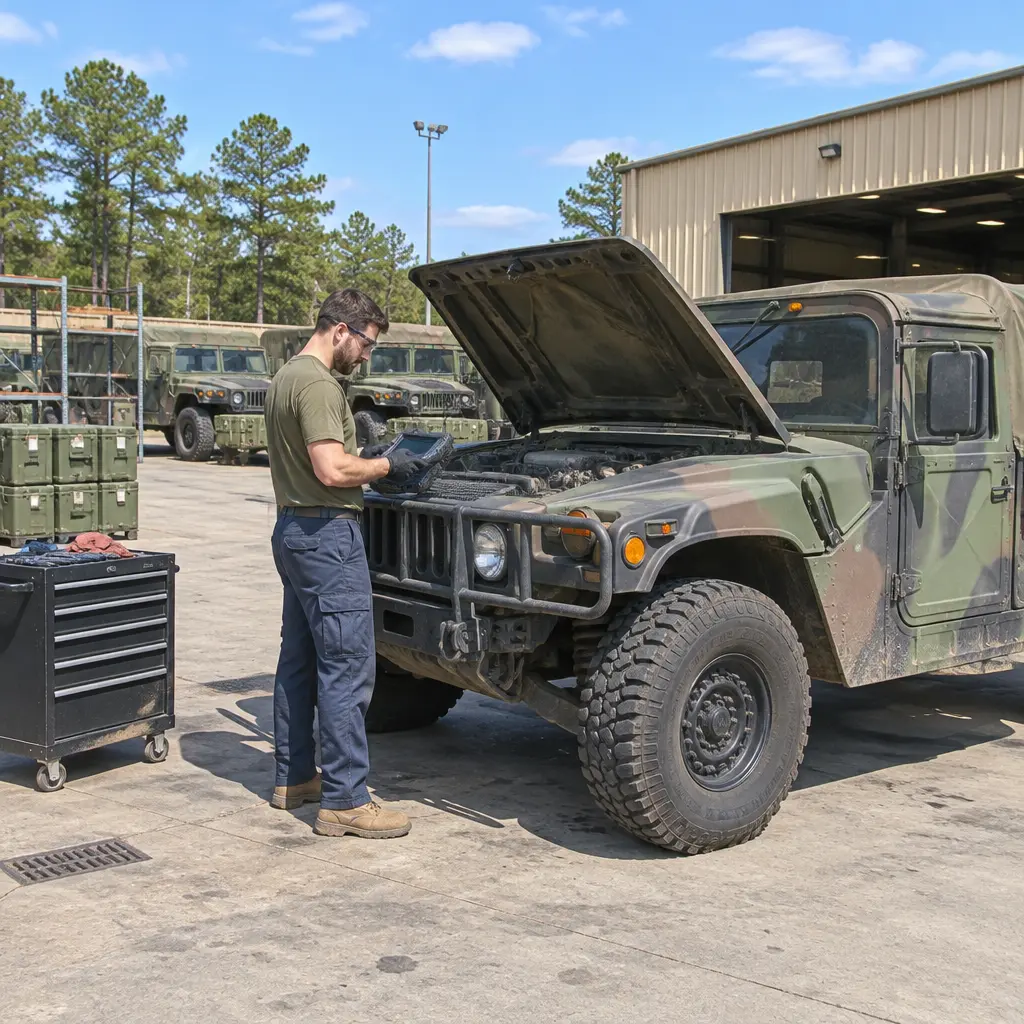
Military vehicle maintenance protocols that prioritize operational readiness use vehicle condition, mission demand, and risk to guide maintenance decisions rather than relying on calendar intervals alone. This is not permission to disregard technical manuals or mandatory inspections: it is a disciplined approach that combines required checks with condition-based monitoring, preventive care, and rapid fault correction. The U.S. Government Accountability Office has repeatedly identified maintenance, parts availability, and workforce capacity as factors affecting the readiness of military fleets. A readiness-focused protocol therefore needs clear safety limits, reliable fault reporting, trained maintainers, and metrics that show whether vehicles are available and mission-capable.
Readiness-Based Maintenance Defines Vehicle Availability as the Priority
Operational readiness is the ability of a force or unit to perform its assigned missions. For vehicles, the practical measure is whether equipment is safe, serviceable, properly configured, and available when required. The U.S. Department of Defense uses readiness reporting systems to assess unit capability; specific measures and reporting rules vary by service and equipment. In maintenance planning, readiness-based maintenance means arranging work to protect mission capability while still meeting technical, safety, and regulatory requirements.
The term covers several related practices: preventive maintenance, condition-based maintenance, predictive maintenance, corrective maintenance, and reliability-centered maintenance. These methods are complementary rather than interchangeable. Scheduled inspections remain essential for detecting age-related degradation and satisfying prescribed requirements, while condition information helps commanders and maintainers decide where attention is most urgent.
Availability, mission capability, and maintenance backlog
Availability describes whether a vehicle can be used when needed; mission capability describes whether it can perform its assigned task. A vehicle may be available for limited duties but not capable of a mission requiring a particular communications suite, armor configuration, or mobility standard. Maintenance backlogs, delayed parts, and shortages of qualified personnel can reduce both measures. GAO reports on weapon-system sustainment have documented persistent challenges involving maintenance, supply support, and the quality of readiness data, underscoring why a single “available” figure may not fully describe operational capacity.
Readiness-first does not mean interval-free maintenance
A readiness-first protocol does not authorize units to extend, skip, or alter mandatory inspections without approval. Maintenance manuals, safety notices, engineering instructions, and applicable service policies remain controlling. The protocol instead prioritizes work within those rules: safety-critical defects receive immediate attention, mission-essential vehicles receive appropriately prioritized support, and lower-risk work is scheduled to reduce unnecessary downtime without creating hidden hazards.
Condition-Based Maintenance Connects Vehicle Health to Maintenance Decisions
Condition-based maintenance (CBM) is maintenance initiated or adjusted using evidence of an asset’s actual condition. The Department of Defense’s CBM+ approach extends this concept by integrating condition data, diagnostics, prognostics, logistics, and maintenance planning to improve readiness and reduce life-cycle costs. Instead of treating a mileage or time interval as the only signal, maintainers consider operating hours, fault codes, inspection findings, usage severity, and component trends alongside required schedules.
The key benefit is better prioritization, not the elimination of preventive maintenance. A vehicle operating in dust, extreme heat, deep mud, or repeated stop-start conditions may need attention sooner than one used lightly in a benign environment. Conversely, reliable condition evidence may help planners avoid unnecessary early replacement where policy permits, preserving parts and labor for more urgent faults.
Preventive and scheduled maintenance
Preventive maintenance consists of planned inspections and servicing intended to reduce the likelihood of failure. Scheduled intervals can be based on time, mileage, engine hours, or other measures specified by the equipment’s technical documentation. These checks are especially important for components whose deterioration may not be obvious to operators, including fluid systems, brakes, electrical connections, and safety devices. Readiness planning should coordinate scheduled work with mission calendars where possible, but operational urgency cannot override mandatory technical requirements.
Condition monitoring and predictive maintenance
Condition monitoring uses observations or instrument data—such as fluid analysis, vibration, temperature, diagnostic trouble codes, and component wear—to assess vehicle health. Predictive maintenance goes further by using trends or analytical models to estimate when a failure may occur, allowing work to be planned before the fault causes a mission interruption. The Department of Defense describes CBM+ as a way to use data and technology to support maintenance decisions across an asset’s life cycle. Its effectiveness depends on accurate records, suitable sensors, validated models, and maintainers who can interpret the results.
Corrective maintenance and fault triage
Corrective maintenance restores equipment after a fault is found. A readiness-focused triage system ranks faults by consequences: immediate danger to personnel, risk of catastrophic damage, loss of essential mission capability, and lesser degradation. For example, a defect affecting steering or braking requires a different response from a noncritical comfort-system fault. The exact classification must follow the vehicle’s technical guidance and local safety procedures; operators should not make unauthorized repairs or continue operating equipment with a prohibited defect.
Maintenance Prioritization Balances Mission Demand, Risk, and Resources
A readiness-centered maintenance queue weighs the mission requirement against technical risk and the resources required to return a vehicle to service. It distinguishes urgent safety or reliability work from tasks that can be scheduled during planned downtime. This approach is most effective when commanders, operators, maintainers, supply personnel, and engineering authorities share a common picture of vehicle status and parts constraints.
Risk-based work ordering
Risk-based work ordering ranks maintenance by the likelihood and consequence of failure. High-consequence defects—including those affecting mobility, fire safety, braking, steering, or crew protection—should receive immediate assessment under applicable technical procedures. Lower-risk defects can be grouped into planned work when authorized. A useful work-order record identifies the reported symptom, diagnostic result, operational impact, required parts, repair authority, and verification step, helping prevent repeated troubleshooting and incomplete handoffs.
Mission scheduling and fleet-level allocation
Fleet-level allocation considers which vehicles are needed for upcoming tasks, how many equivalent vehicles remain available, and whether a vehicle’s configuration suits the mission. A unit may prioritize a mission-essential vehicle for a short repair while routing another vehicle into a longer overhaul, provided that safety and technical requirements are met. Maintenance planners should also preserve time for inspections, recovery, and post-operation servicing rather than treating every vehicle as continuously deployable.
Parts, workforce, and maintenance capacity
A technically sound priority system cannot restore readiness if essential parts, tools, facilities, or qualified personnel are unavailable. GAO sustainment reviews have highlighted supply-chain and maintenance-capacity issues across defense programs, including delays that can keep equipment unavailable even after a fault is diagnosed. Units can improve responsiveness by tracking high-demand repair parts, identifying repairable components, using accurate demand forecasts, and reporting supply delays separately from repair time. These measures also help leaders distinguish a maintenance problem from a logistics bottleneck.
Readiness Metrics Validate Whether the Protocol Works
Metrics validate whether maintenance decisions improve usable capability without increasing unsafe operation or long-term degradation. No single metric is sufficient: availability can rise temporarily if work is deferred, while a high repair count may reflect improved fault reporting rather than worsening reliability. Leaders should read readiness indicators alongside safety findings, repeat faults, parts delays, and scheduled-maintenance compliance.
Operational availability and mission-capable rates
Operational availability estimates the proportion of time an asset is ready for use, while mission-capable rates indicate the proportion meeting a defined mission standard. The calculation and reporting period should be consistent across units and aligned with service guidance. A dashboard can show the number of vehicles available, limited by mission, or unavailable, together with the cause and expected recovery date. This breakdown is more useful than a fleet-wide percentage alone because it identifies whether a readiness gap stems from maintenance, supply, personnel, or configuration.
Mean time to repair and repeat-fault rates
Mean time to repair measures the average time required to restore an asset after a failure, though organizations may define start and stop points differently. Repeat-fault rates track defects that recur after repair and can reveal incomplete diagnosis, poor-quality parts, or an underlying design or operating problem. Both metrics should be interpreted with vehicle complexity and mission conditions in mind. A shorter repair time is not a success if repairs fail verification or lead to recurring faults.
Compliance, safety, and data quality
A balanced scorecard tracks required inspection completion, overdue work, safety-related defects, maintenance-induced failures, and record accuracy. Data quality matters because decisions based on incomplete fault histories can misdirect labor and supplies. The National Institute of Standards and Technology’s reliability and maintenance publications emphasize systematic data collection and analysis as foundations for sound asset-management decisions. For military fleets, commanders should use the service’s authorized systems and definitions rather than mixing incompatible local measures.
Implementation Requires Governance, Training, and Feedback
Implementing readiness-focused protocols requires formal decision rights, standardized reporting, and a feedback loop from operators to maintainers and planners. Technology alone cannot ensure readiness: inaccurate records, untrained users, or unclear repair authority can undermine even sophisticated diagnostics. A practical rollout begins with the existing technical and safety rules, identifies recurring availability constraints, and tests improvements on a manageable fleet segment before broader adoption.
Operator inspections and fault reporting
Operators are often the first to observe changes in sound, vibration, handling, fluid levels, or warning indicators. Standardized pre-operation and post-operation checks help turn these observations into actionable maintenance records. Training should explain how to report symptoms clearly, preserve diagnostic information, and stop operation when required by safety guidance. Operators should not be expected to diagnose beyond their qualifications or substitute informal judgment for approved procedures.
Technical authority and change control
Technical authorities establish approved maintenance limits, inspection procedures, repair standards, and engineering changes. Any adjustment to intervals, inspection scope, or approved repair methods must follow the relevant service authorization and configuration-control process. This safeguard prevents local readiness pressures from producing inconsistent standards or transferring risk to crews and downstream units.
Review cycles and learning from field experience
Regular reviews compare readiness outcomes with failure trends, repair quality, parts availability, and safety reports. When a recurring defect appears across vehicles, the response may involve revised training, a supply adjustment, an engineering investigation, or a maintenance-policy change through authorized channels. Historical maintenance records and after-action findings can help separate isolated failures from fleet-wide patterns, making the protocol adaptive without weakening technical discipline.
Conclusion: Readiness and Technical Discipline Must Work Together
Military vehicle maintenance protocols that prioritize operational readiness combine scheduled preventive care with condition-based evidence, risk-based fault triage, mission-aware resource allocation, and metrics that reveal actual capability. Availability and mission-capable rates show whether vehicles can perform; repair and repeat-fault measures show how well maintenance restores them; safety, compliance, and data-quality checks guard against short-term gains that create longer-term risk.
The broader implication is that readiness is a coordinated logistics and maintenance outcome, not simply a matter of servicing vehicles more often or less often. Units should review their governing technical manuals and service policies, strengthen operator reporting and maintenance data, and use authorized condition-based methods to target effort where it has the greatest operational value.
Sources: U.S. Government Accountability Office, Weapon Systems Annual Assessment, https://www.gao.gov/products/gao-24-106831; U.S. Department of Defense, Condition-Based Maintenance Plus (CBM+), https://www.acq.osd.mil/log/LOG_Services/CBM+.html; U.S. Department of Defense, DoD Instruction 4151.22, Condition-Based Maintenance Plus for Materiel Maintenance, https://www.esd.whs.mil/Portals/54/Documents/DD/issuances/dodi/415122p.pdf; National Institute of Standards and Technology, NIST Handbook 135, Life-Cycle Costing Manual for the Federal Energy Management Program, https://www.nist.gov/publications/life-cycle-costing-manual-federal-energy-management-program.