
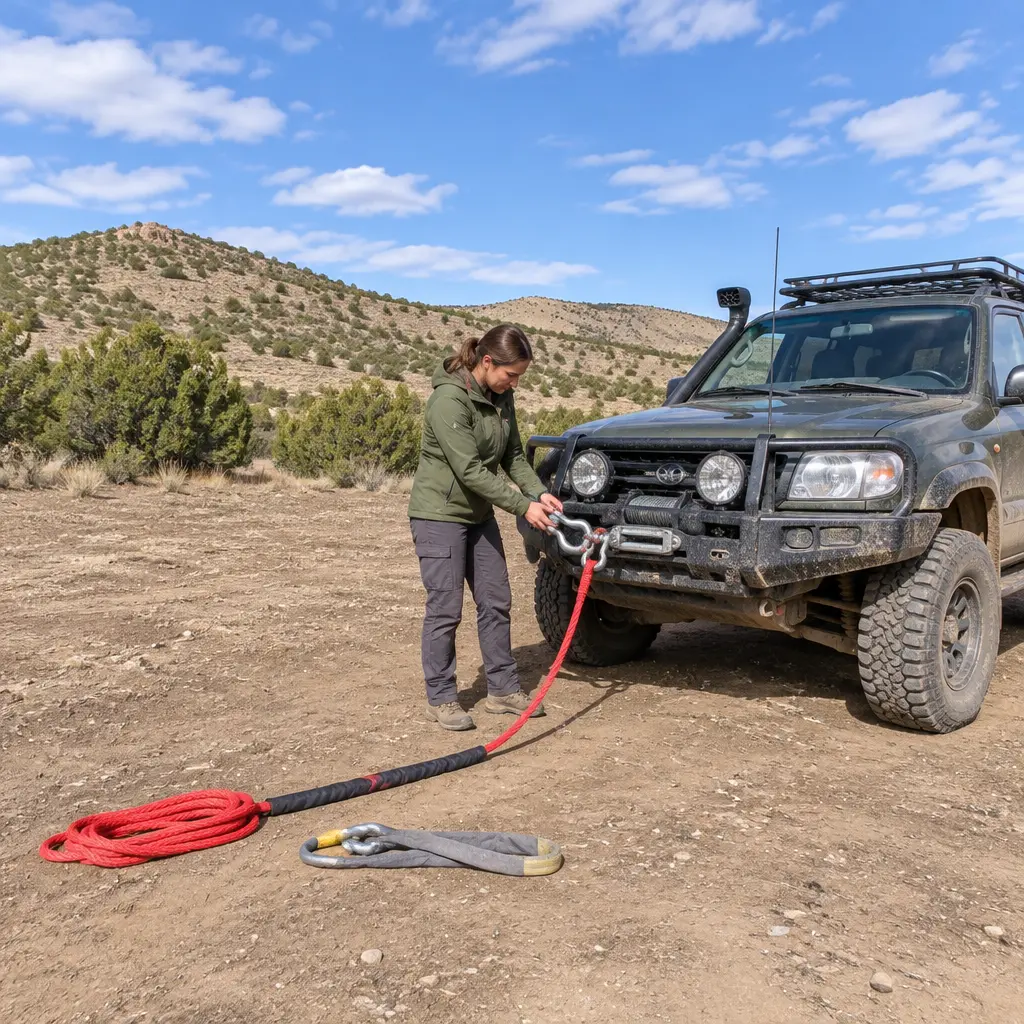
A vehicle recovery system’s capacity is the load it can safely handle in a defined recovery configuration—not simply the vehicle’s advertised curb weight or the number printed on a strap. Because mud, sand, slopes, buried wheels, braking, and abrupt loading can greatly increase extraction forces, size the complete recovery system for the worst credible pull, then verify every component’s working-load limit (WLL), compatibility, and manufacturer instructions. This approach follows the central safety distinction made by standards bodies and recovery-equipment manufacturers: rated capacity applies under specified conditions, while real-world loads can change with geometry and technique.
Recovery-system capacity reflects the worst-case extraction load
A vehicle recovery system is the connected set of vehicle attachment points, winch or recovery line, connectors, rigging, and any redirecting equipment used to move a disabled or stuck vehicle. Its capacity is governed by the weakest applicable component and by the load each component actually experiences. The Society of Automotive Engineers’ J706 standard addresses winches for recovery service, while standards and guidance for lifting and rigging distinguish a component’s rated capacity from the forces created by a particular setup. A nominal vehicle weight rating is therefore a starting reference, not proof that a recovery configuration is adequate.
The practical sizing question is: “What force could this extraction impose on the system?” rather than “How heavy is the vehicle?” A rolling vehicle on firm ground may need modest force; the same vehicle with its axles buried, underbody grounded, brakes applied, or positioned on a slope may demand substantially more. A dynamic snatch recovery can add a sharp transient load. Because the actual resistance is difficult to predict precisely, use conservative margins, avoid shock loading unless the equipment is specifically designed and used for that purpose, and follow the recovery-device maker’s instructions.
Extraction force defines vehicle recovery-system capacity
Extraction force is the pull required to overcome the resistance preventing a vehicle from moving. The U.S. Army’s recovery and towing guidance treats resistance as a combination of factors such as rolling resistance, grade, and terrain; the exact force depends on the vehicle and conditions. This is why vehicle mass alone cannot supply a reliable worst-case rating. A vehicle that weighs 3,000 kilograms can require far less than its weight to roll freely—or a force approaching or exceeding its weight when deeply immobilized or subjected to a severe upward or forward pull.
For a simplified illustration, grade resistance on a slope is approximately vehicle weight multiplied by the sine of the slope angle. Rolling resistance adds another term, while buried tires, high-centering, suction in mud, obstacles, and drivetrain or brake drag can add unpredictable resistance. These estimates help identify risk but do not replace a load measurement or a qualified recovery plan. If the load is unknown, do not assume a familiar rule of thumb guarantees safety.
Vehicle mass and terrain resistance
Curb weight is the vehicle’s weight without occupants or cargo under the manufacturer’s stated definition; actual recovery mass may be higher because of passengers, equipment, fuel, and payload. Terrain then changes the force needed to move that mass. Firm gravel may allow the tires to roll, while soft sand or mud can cause tire sinkage, bulldozing resistance, and suction around the vehicle. High-centering can transfer load onto the chassis and effectively prevent the wheels from providing useful traction.
A useful field assessment records the loaded vehicle mass, slope, wheel condition, ground type, and whether the vehicle is free-rolling or mechanically restrained. These details do not produce a guaranteed extraction force, but they make clear why two recoveries involving the same model can require very different equipment. Where the vehicle is heavily buried, perched on an edge, or at risk of rolling, use trained recovery personnel and suitable engineered equipment rather than escalating force by trial and error.
Static pulls, winching, and dynamic recovery
A static winch pull builds tension progressively when operated correctly, allowing the operator to monitor the load and stop if the vehicle or rigging shifts. A dynamic recovery uses the motion and stretch of a purpose-designed kinetic rope or strap to help free a vehicle. That elastic energy can create loads that rise rapidly, so a kinetic recovery is not equivalent to a steady winch pull. The rope, attachment points, connectors, and technique must all be suitable for dynamic recovery; ordinary tow straps and improvised hardware are not substitutes.
In either method, abrupt acceleration, slack in a line, a sudden snag, or a change in direction can produce peak loads well above the steady resistance. The U.S. National Park Service and other public-safety agencies warn that recovery lines and attachment failures can release dangerous energy. Keep bystanders clear of the line and its potential recoil path, use a line damper where appropriate, and never stand over, step across, or handle a tensioned line.
Component ratings determine usable recovery-system capacity
The usable capacity of a recovery system is limited by its weakest component in the actual configuration. Relevant items include the winch, synthetic rope or wire rope, vehicle recovery points, shackles or soft shackles, tree protector, snatch block, and any extension line. The rating must be interpreted as the manufacturer defines it—such as WLL, breaking strength, or a specific recovery rating—and not treated as interchangeable with other rating terms.
The Occupational Safety and Health Administration’s rigging rules define working-load limits in the context of rated equipment and safe use, and require rigging to be inspected and used within its rated capacity. A breaking-strength figure describes failure testing or ultimate strength, not a load that should routinely be applied. Do not create a system rating by adding component numbers, and do not assume that a component remains adequately rated after wear, damage, modification, side-loading, or use outside its intended configuration.
Winch, rope, and vehicle attachment ratings
A winch’s stated pull rating is commonly associated with a particular layer of rope on its drum; as rope builds up on the drum, effective pulling force generally decreases. Consult the winch maker’s load chart and instructions rather than assuming the headline rating applies in every configuration. The rope must also be matched to the winch, maintained, and inspected for abrasion, cuts, heat damage, corrosion in wire rope, or other defects.
Vehicle recovery points are equally important. A factory tie-down or transport point may not be approved for recovery, and a bumper, suspension arm, or tow ball should not be used as an improvised anchor. Use only manufacturer-designated recovery points with stated recovery suitability. The Society of Automotive Engineers’ J706 standard provides a recognized framework for recovery winch performance, but compliance does not make an unsuitable vehicle attachment point safe.
Connectors, redirecting blocks, and rigging geometry
Shackles, soft shackles, and hooks must be compatible with the connected equipment and loaded in their intended direction. Side-loading, sharp edges, knots, and incompatible pin or eye dimensions can reduce capacity or cause damage. A snatch block can redirect a line and, in a correctly arranged two-part pull, reduce the winch-line force needed for a given vehicle force; however, the block and anchor experience their own loads, and friction means the force is not divided perfectly. The anchor and all connected hardware must be rated for the resulting vector loads.
Rigging geometry can also magnify force. For example, a shallow sling angle places greater tension in each leg than a vertical or near-vertical arrangement. The Crosby Group’s rigging guidance describes how sling-angle effects increase leg tension as the angle decreases. Recovery setups should therefore avoid narrow, highly tensioned angles and should be checked as a complete load path—not as a collection of individually impressive ratings.
Recovery margins and configuration govern safe sizing
A safety margin accounts for uncertainty in vehicle resistance, load measurement, hardware condition, and operating technique. It is not a license to exceed a component’s rating, nor does a large nominal rating eliminate hazards from poor anchors or dynamic loading. Select equipment using the manufacturer’s stated WLL or recovery rating, the likely worst-case extraction, and any limits for direction, line layers, temperature, or use. If the expected load cannot be estimated with confidence, the safer response is to reduce resistance, change the pull geometry, or obtain professional assistance.
Before applying force, reduce the extraction demand where possible: clear material from around the tires, lower tire pressure only within safe limits and reinflate before normal road use, straighten the vehicle’s path, and use traction boards or a shovel. These methods can prevent a high-force pull. Never use a recovery line to lift a person, and do not attach to an unverified point or use a vehicle’s momentum with equipment not designed for kinetic recovery.
A practical worst-case sizing sequence
- Determine the vehicle’s actual loaded mass and identify whether it is rolling freely, buried, high-centered, on a slope, or mechanically restrained.
- Assess the intended pull direction, ground conditions, anchor strength, and the chance of sudden snagging or vehicle movement.
- Choose a recovery method—controlled winching, kinetic recovery, or another suitable technique—and use only equipment designed for that method.
- Check the rating and condition of every component in the load path, including the vehicle attachment and anchor. Apply the lowest relevant rating and all manufacturer limitations.
- Configure blocks, slings, and connectors to avoid side-loads, sharp edges, poor angles, and unintended load multiplication.
- Establish an exclusion zone, communicate a stop signal, keep people out of the line of pull and recoil path, and increase force gradually while monitoring the setup.
- Stop if the vehicle or anchor shifts, a component deforms, the line is damaged, or the required force appears beyond the system’s verified capacity.
Inspection, maintenance, and real-world risk
Recovery equipment is only as reliable as its current condition. Inspect ropes, straps, winches, connectors, and recovery points before and after use; remove damaged equipment from service according to the manufacturer’s criteria. Keep synthetic rope clean and protected from abrasion and heat, and inspect wire rope for broken wires, kinks, crushing, and corrosion. OSHA’s general rigging requirements emphasize inspection and removal of defective equipment in covered workplace operations, a principle that is also prudent for recreational recovery.
A common failure pattern is not simply “the strap was too small.” Failures can originate at an underrated factory tie-down, a tow ball used as an anchor, a damaged connector, a sideways-loaded shackle, or a sudden jerk that turns a manageable pull into a shock load. Public safety agencies and recovery-equipment manufacturers repeatedly caution that detached metal hardware and tensioned lines can become projectiles. A conservative, controlled recovery protects not only the vehicle but also everyone nearby.
Conclusion: Size recovery systems for extraction force, not curb weight alone
Vehicle recovery-system capacity depends on the extraction force created by mass, terrain, slope, burial, rigging geometry, and recovery technique. Component ratings describe limits under defined conditions; they do not guarantee that a complete system is safe when one part is damaged, misused, or dynamically overloaded. The most reliable practice is to assess the worst credible load, use compatible rated equipment throughout the load path, reduce resistance before pulling, and keep people outside the danger zone.
Before your next trip, review the vehicle manufacturer’s recovery-point guidance and each equipment maker’s instructions, inspect your gear, and practice with a qualified instructor in controlled conditions. For difficult or high-consequence extractions, call a professional recovery operator rather than relying on a nominal weight rating or an improvised rule of thumb.
Sources: Society of Automotive Engineers, SAE J706, Rating of Winches for Recovery Service, https://www.sae.org/standards/content/j706_201607/; Occupational Safety and Health Administration, 29 CFR 1910.184, Slings, https://www.osha.gov/laws-regs/regulations/standardnumber/1910/1910.184; U.S. Army, FM 4-30.31, Recovery and Battle Damage Assessment and Repair, https://armypubs.army.mil/; The Crosby Group, General Catalog and Rigging Safety Guidelines, https://www.thecrosbygroup.com/; U.S. National Park Service, Vehicle Recovery and Winching Safety Guidance, https://www.nps.gov/