
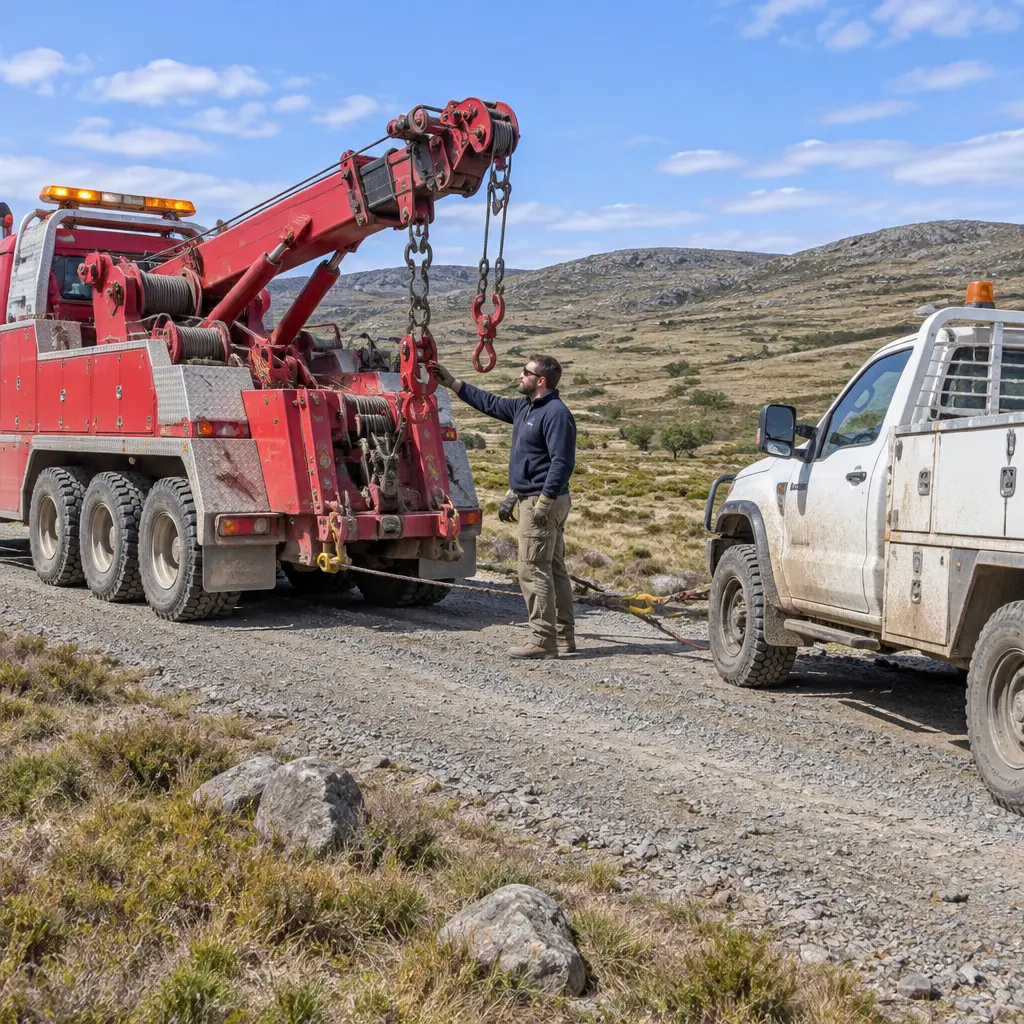
Heavy-extraction field recovery is the planned movement of disabled vehicles, machinery, or other heavy assets from locations where terrain, weather, access, or security make ordinary towing unsafe or ineffective. Successful deployments combine a verified recovery plan, suitable winches and rigging, ground and vehicle stabilization, communications, and continuous hazard assessment. The need is practical as well as strategic: the U.S. Federal Highway Administration reports that traffic incidents involving large trucks can create substantial roadway disruption, while the U.S. Army’s recovery doctrine treats recovery as a coordinated operation rather than a single-pull task. In hostile terrain, the safest tactic is therefore to match equipment and method to the ground, control loads and exclusion zones, and stop when conditions exceed the plan or team’s capability.
Recovery planning defines heavy extraction systems in hostile terrain
A heavy extraction system is a combination of a recovery vehicle or machine, winches or lifting equipment, rated rigging, anchors, personnel, and procedures used to move an immobilized heavy asset. The U.S. Army’s field-maintenance doctrine describes recovery as returning disabled equipment to a place where it can be repaired or evacuated; the specific method depends on the asset, its condition, the route, and available resources. “Hostile terrain” in this context means ground or environmental conditions that make access, traction, stability, visibility, or safe work difficult—not necessarily hostile human activity.
Common recovery categories include self-recovery, like-vehicle recovery, dedicated wrecker or recovery-vehicle operations, crane or lifting recovery, and staged recovery using multiple assets. These are not interchangeable. A vehicle winch may be suitable for a controlled drag, while a crane-assisted lift may be needed to clear an obstacle; neither should be selected without confirming load limits, anchor capacity, and the condition of the asset. The U.S. Army’s ATP 4-31, Recovery and Battle Damage Assessment and Repair, emphasizes planning, equipment selection, and coordination as parts of the recovery mission.
Mission assessment and recovery planning
A recovery plan is the documented sequence for reaching, stabilizing, extracting, and moving the disabled asset. It begins with the asset’s weight and configuration, damage state, access route, slope, soil or surface conditions, weather, overhead and buried hazards, and the destination. Teams should identify a primary method and a realistic alternate before applying force. The U.S. Army’s recovery guidance supports this deliberate approach because a change in load, ground conditions, or equipment position can alter the entire operation.
Planning should include a site briefing, designated operator and signaler, communications checks, exclusion zones, emergency stop signals, and clear authority to halt work. If the asset contains fuel, batteries, pressurized systems, hazardous cargo, or damaged high-voltage components, those hazards must be assessed before rigging begins. A recovery plan is not a guarantee that the operation will proceed; it is a basis for deciding whether the operation remains safe as conditions change.
Load control, rigging, and equipment ratings
Rigging is the chain of rated components—such as wire rope, synthetic line, shackles, slings, pulleys, and attachment points—that transfers force from the recovery system to the load. Each component must be suitable for the expected force, direction, and environment, and must be inspected before use. The Occupational Safety and Health Administration’s regulations for material handling and slings require attention to rated capacities and removal of damaged equipment from service. A component’s working-load limit is not a suggestion to exceed when a recovery becomes difficult.
Recovery force can rise sharply when a vehicle is deeply sunk, snagged, or forced to climb a steep grade. Multi-part line systems can reduce the load on a winch in ideal conditions, but they add components and change line direction, creating additional failure points and anchor loads. Personnel should stay out of the line of pull and potential recoil area, use approved line dampers where appropriate, and follow the equipment manufacturer’s limits. No one should stand over, step across, or handle a tensioned line.
Terrain assessment determines heavy extraction tactics
Terrain assessment is the evaluation of ground strength, slope, traction, drainage, obstacles, and access routes to determine whether a recovery vehicle and its anchors can support the operation. The U.S. Army Corps of Engineers’ engineering guidance and Federal Highway Administration materials on geotechnical and roadway conditions illustrate why surface appearance alone is unreliable: saturated soil, loose fill, and hidden voids can fail under concentrated loads. The appropriate tactic is the one that controls vehicle movement and ground pressure while avoiding unnecessary disturbance or secondary immobilization.
Terrain-related recovery methods include traction improvement, controlled winching, towing, lifting, route preparation, and recovery from soft ground with mats or other load-spreading measures. Selection depends on the asset and site; a method that works on firm gravel may be unsafe in mud, snow, sand, or fractured rock. A useful visual for field teams is a terrain-and-method matrix showing ground condition, slope, access, anchor options, and the approved recovery method. The matrix should support—not replace—an on-site assessment.
Soft ground, mud, and saturated soils
Soft-ground recovery involves reducing sinkage and controlling traction when soil cannot support the vehicle’s contact pressure. Saturated soil can lose strength, and repeated wheelspin may excavate the ground, deepen the immobilization, and damage the route. Teams can consider load-spreading mats, suitable track or tire pressure procedures, a recovery vehicle positioned on firmer ground, or a controlled pull aligned with the asset’s structure—provided equipment manuals and local safety rules allow the method.
The U.S. Army Corps of Engineers’ wetland and soil resources stress that water content and soil type affect bearing behavior; there is no universal “safe” ground-pressure figure applicable to every field site. Operators should therefore test and observe the actual route, avoid placing heavy recovery equipment near unsupported edges, and stop if the anchor vehicle begins to sink or shift. A second vehicle should not be added merely to increase force unless its position and combined loads have been assessed.
Slopes, obstacles, and unstable terrain
Slope recovery is the movement of an asset where gravity, side-loading, rollover risk, or sliding can overwhelm traction and steering. Before applying tension, teams should identify the likely path of the asset and recovery vehicle, secure the area, and avoid side pulls that can twist rigging or destabilize equipment. On steep or uneven ground, the safer choice may be to reposition the recovery vehicle, prepare a stable working platform, or use a controlled lift rather than a direct pull.
Rock, debris, snow, and collapsed surfaces introduce additional hazards, including sharp edges that can damage lines, concealed gaps, and sudden changes in grip. The National Institute for Occupational Safety and Health (NIOSH) identifies vehicle incidents and hazardous work environments as persistent occupational risks; its prevention principles reinforce the value of hazard recognition, controlled access, and stopping work when conditions change. Recovery teams should not assume that a static assessment remains valid after rain, thaw, vibration, or movement of the load.
Operational controls reduce risk during heavy extraction
Operational controls are the procedures and safeguards that limit exposure to stored energy, moving equipment, unstable loads, and environmental hazards. They include trained operators, equipment inspection, clear communication, exclusion zones, line-of-fire awareness, and a stop-work process. OSHA’s construction and material-handling standards establish requirements for safe equipment and rigging practices in covered workplaces, while NIOSH’s incident-prevention work highlights the importance of planning and hazard controls. These principles apply whether the operation takes place on a road, in a remote worksite, or in an emergency response area.
Personnel roles, communications, and exclusion zones
A recovery team should assign roles before tension is applied: an operation lead, equipment operator, signaler, and, when needed, a safety observer. Only one person should direct the movement unless an emergency stop is required. Radios or agreed hand signals should be tested in advance, and the team should establish a universally understood stop command. People not essential to the operation should remain outside the controlled area, particularly away from the line of pull, vehicle travel path, and potential recoil zone.
Communication is especially important where engines, wind, weather, or terrain block visibility. The operator should pause if signals are lost or unclear rather than continuing based on assumption. A brief before-action review and a post-operation review can identify procedural gaps, equipment damage, or near misses for correction before the next deployment.
Inspection, maintenance, and environmental protection
Inspection verifies that recovery equipment remains fit for service after exposure to shock loads, abrasion, corrosion, contamination, or prolonged storage. Operators should follow manufacturer inspection intervals and discard or quarantine damaged components. A recovery operation can also create environmental harm through fuel or hydraulic-fluid spills, rutting, vegetation damage, or disturbance of sensitive ground. The U.S. Environmental Protection Agency’s spill-prevention guidance supports planning for containment and prompt reporting where applicable.
Field teams should carry suitable spill-control materials when the asset or site presents a leakage risk, avoid unnecessary route widening, and document any damage to the site. In protected areas or on public lands, permits and land-manager directions may constrain access, anchoring, and ground disturbance. Environmental controls are part of the recovery plan, not an afterthought.
Case studies show how recovery systems adapt to field conditions
Real-world incidents demonstrate that recovery is a system problem: access, vehicle condition, weather, traffic, and personnel safety interact. The examples below illustrate planning lessons rather than prescribing a universal method. The appropriate procedure in any live incident depends on local authorities, equipment manuals, and competent on-site assessment.
Large-vehicle incidents and roadway access
The Federal Highway Administration’s Traffic Incident Management resources describe the need for coordinated response to roadway incidents, including safe scene access, traffic control, and rapid clearance. For a disabled heavy truck, extraction may require heavy wreckers, staged towing, load transfer, or recovery of cargo before the vehicle can be moved. The central lesson is that traffic protection and responder coordination must be planned alongside the mechanical recovery; a technically successful pull is not successful if the work zone exposes responders or road users to avoidable danger.
Military and remote-field recovery
U.S. Army recovery doctrine treats disabled equipment as a logistics and maintenance challenge, with recovery assets selected according to the vehicle class, condition, route, and operational setting. In remote terrain, the recovery team may need to establish communications, secure a route, and determine whether the asset can be moved without worsening damage. This structured approach is relevant to civilian sectors such as mining, forestry, utilities, and disaster response, where heavy equipment may be stranded far from paved access.
A useful field graphic would be a decision-flow diagram: assess hazards and asset condition; confirm ground and anchor capacity; choose a rated method; establish communications and exclusion zones; apply controlled force; reassess after each movement; and stop or escalate if the plan’s assumptions fail. The graphic should prominently distinguish a planned recovery from an improvised attempt.
Conclusion: disciplined planning makes heavy extraction safer
Heavy extraction in hostile terrain depends on a matched system of recovery equipment, rated rigging, ground assessment, skilled personnel, and operational controls. Recovery planning defines the task; terrain assessment determines whether the selected method is viable; and communications, inspection, exclusion zones, and environmental safeguards reduce the chance of secondary harm. Army recovery doctrine, OSHA requirements, NIOSH prevention guidance, and FHWA incident-management resources all point toward the same principle: control the operation rather than relying on brute force.
Organizations that deploy heavy recovery systems should train teams on equipment-specific procedures, maintain documented inspection records, conduct briefings and after-action reviews, and ensure that personnel can stop an unsafe operation. For further study, consult the applicable equipment manuals, local workplace-safety rules, land-manager requirements, and formal recovery doctrine before developing site-specific procedures.
Sources: U.S. Army, ATP 4-31, Recovery and Battle Damage Assessment and Repair, https://armypubs.army.mil/; Occupational Safety and Health Administration, 29 CFR 1910.184, Slings, https://www.osha.gov/laws-regs/regulations/standardnumber/1910/1910.184; Occupational Safety and Health Administration, 29 CFR 1926.251, Rigging Equipment for Material Handling, https://www.osha.gov/laws-regs/regulations/standardnumber/1926/1926.251; National Institute for Occupational Safety and Health, Workplace Safety and Health Topics, https://www.cdc.gov/niosh/topics/; Federal Highway Administration, Traffic Incident Management, https://ops.fhwa.dot.gov/eto_tim/; U.S. Army Corps of Engineers, Engineer Manuals and Publications, https://www.publications.usace.army.mil/; U.S. Environmental Protection Agency, Spill Prevention, Control, and Countermeasure (SPCC) Rule, https://www.epa.gov/oil-spills-prevention-and-preparedness-regulations