
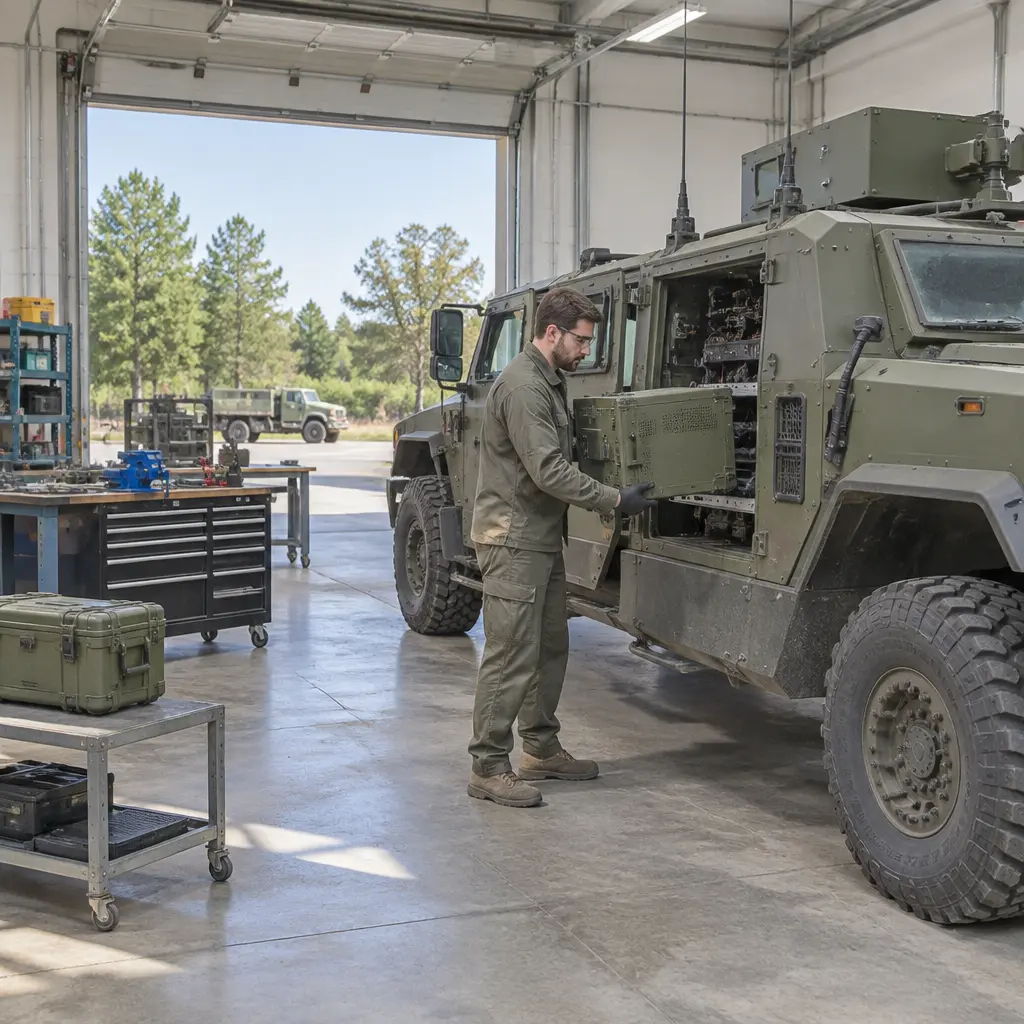
Modular engineering design is the practice of dividing a system into distinct, standardized units that can be assembled, removed, or replaced through defined interfaces. For military equipment, this approach can make battlefield repairs faster by letting maintainers replace a failed module—such as a power unit, sensor, or communications component—instead of diagnosing and rebuilding the entire system on site. Its effectiveness depends on interface standards, diagnostics, logistics, training, and protection against environmental and cyber threats. The U.S. Government Accountability Office has repeatedly identified sustainment and parts availability as major contributors to weapon-system readiness, while the Department of Defense’s Modular Open Systems Approach (MOSA) policy promotes modular, interoperable designs. Together, these findings make modularity a practical readiness strategy, though not a guarantee of faster repairs by itself.
Modular design enables rapid component swaps in battlefield maintenance
Modular engineering design for battlefield repair means creating equipment from functional units connected by documented mechanical, electrical, software, and data interfaces. A maintainer can then isolate a fault, remove the affected unit, install a serviceable replacement, and verify operation using approved procedures. The method is relevant to vehicles, aircraft, radios, power systems, sensors, and command networks, but the achievable time savings vary by equipment and operating conditions. Public sources do not establish one universal percentage reduction in repair time across military systems; performance must be measured for each design and repair task.
Modular engineering design improves repairability through defined interfaces
A module is a bounded functional unit whose internal design can be changed without requiring redesign of every connected unit, provided its external interfaces and performance requirements remain compatible. The U.S. Department of Defense defines MOSA as an integrated business and technical strategy for designing systems with modular, loosely coupled, and highly cohesive elements, supported by widely supported, consensus-based standards. This definition emphasizes that modularity is more than making parts detachable: it requires planned boundaries, documented interfaces, and the ability to integrate and test replacements.
The U.S. Government Accountability Office has described sustainment challenges—including maintenance demands and supply constraints—as factors that can affect aircraft and other weapon-system availability. Modularity addresses part of this problem by making components easier to isolate and exchange, but it cannot compensate for missing spares, inadequate tools, unsafe access, or a replacement that requires extensive recalibration.
Line-replaceable units support field-level exchange
A line-replaceable unit (LRU) is an equipment assembly designed to be removed and replaced at an operational maintenance location, rather than repaired internally at that location. Common examples include radio transceivers, power supplies, displays, and electronic control units. LRUs can shorten the repair task when the fault can be localized to the unit, the replacement is available, and connectors, fasteners, and access points are designed for field handling.
The term does not promise a particular repair time. Maintenance manuals, built-in tests, safe isolation procedures, and post-installation checks determine how quickly and reliably a swap can be completed. A useful design measure is total restoration time: diagnosis, access, removal, replacement, configuration, verification, and return to service—not merely the time spent unplugging and fitting a component.
Line-replaceable modules and shop-level repair serve different needs
A line-replaceable module is a smaller functional unit within an LRU or subsystem. Replacing a whole LRU is often simpler at the point of use; replacing a smaller module can reduce the weight, volume, or cost of the spare carried forward, but may require more troubleshooting and handling. The right maintenance boundary depends on the operational echelon, available tools, personnel skills, and the consequences of a mistaken diagnosis.
This creates a trade-off between rapid exchange and repair depth. A forward team may swap a complete assembly and send the failed unit to a workshop, where technicians can test and repair it under controlled conditions. This “remove and replace, then repair” model can preserve operational tempo while retaining components that are too costly or complex to discard.
Open architectures preserve options for future upgrades
An open architecture uses published, controlled interface specifications and widely supported standards so that components from different suppliers—or later generations—can work together. The Department of Defense’s MOSA policy makes modularity and open systems important considerations in covered acquisitions. In practice, open interfaces can ease replacement and upgrades, but they require disciplined configuration control, interface testing, and clear ownership of technical data.
Open interfaces also help limit dependence on a single supplier, but they do not automatically create competition or interchangeability. A replacement still has to meet physical, electrical, environmental, safety, cybersecurity, and performance requirements. A diagram of a modular repair chain would show the relationship among fault detection, interface-controlled removal, replacement, verification, and replenishment.
Modular repair depends on diagnostics, logistics, and verification
Once equipment is divided into exchangeable modules, the next challenge is identifying which module has failed and ensuring a compatible replacement is available. These supporting systems determine whether modularity produces a real readiness benefit or merely shifts repair work elsewhere. Maintenance data, supply planning, training, and acceptance testing must therefore be designed alongside the hardware.
Built-in test and fault isolation guide the swap
Built-in test (BIT) is a system’s internal capability to check its own functions and report faults. Effective BIT can help maintainers distinguish a failed module from a bad connection, depleted power source, software issue, or fault in an adjacent unit. Diagnostic codes should point to actionable checks rather than simply recommend replacing parts, since false isolation can waste scarce spares and create additional failures.
The verification plan should include checks after installation, such as configuration confirmation, functional tests, and—where required—calibration or alignment. The National Institute of Standards and Technology’s guidance on systems security engineering also underscores that connected components and interfaces must be assessed as part of the system’s security design. A module swap that restores physical function but introduces an unverified software version or unauthorized device can create a new operational risk.
Interchangeability requires controlled standards
Interchangeability means a replacement unit can perform the required function in the intended system without unplanned modification. It depends on more than matching connector shapes: dimensions, power limits, data protocols, software versions, environmental tolerances, and safety constraints must also align. Configuration management records which versions are approved for which platforms and prevents a superficially similar component from being installed incorrectly.
Standards-based interfaces can reduce integration friction, but each interface should be validated under realistic conditions, including vibration, dust, moisture, temperature, electromagnetic interference, and repeated connection cycles. For combat systems, cybersecurity validation and protection against counterfeit or tampered parts are also essential. Testing should confirm both that the replacement works and that it does not degrade other system functions.
Forward spares and repair data determine practical availability
A modular system still needs the right modules in the right locations. The U.S. Government Accountability Office’s weapon-system sustainment work highlights how parts availability and maintenance capacity affect readiness. For modular repair, planners must balance the operational value of carrying spares against transport limits, storage conditions, demand uncertainty, and the cost of maintaining multiple versions.
Useful logistics data include failure rates, repair turnaround, demand by location, replenishment time, and the frequency of no-fault-found returns. Tracking these measures can reveal whether a design is genuinely reducing downtime or simply moving bottlenecks from the repair bench to the supply chain. A chart comparing diagnosis time, parts-wait time, exchange time, and verification time would help identify where improvement is most needed.
Battlefield modularity balances speed with durability and security
Field conditions place unusually high demands on modular interfaces. Components may be handled by personnel wearing protective equipment, repaired in poor light, exposed to contamination, or transported over rough terrain. Modularity must therefore be balanced with ruggedness, protection, and ease of correct assembly. More connectors and separable boundaries can introduce additional failure points if they are not engineered and maintained carefully.
Rugged connections and human factors reduce repair errors
A field-serviceable connection should resist accidental disconnection, contamination, corrosion, vibration, and incorrect mating while remaining accessible with approved tools. Keyed connectors, clear labeling, captive fasteners, safe lifting points, and error-resistant layouts can reduce the likelihood of damage or misinstallation. Design reviews should involve maintainers who perform the actual task, not only engineers working from laboratory conditions.
Repair procedures should specify power isolation, electrostatic-discharge precautions where relevant, torque requirements, sealing checks, and operational verification. A faster swap that compromises a pressure seal, creates a loose connection, or bypasses a safety step is not a readiness improvement. Reliability testing should include repeated removal and installation, not just first-article performance.
Cybersecurity and software configuration are part of the repair
Modern modules may contain firmware, cryptographic material, network identities, or mission data. Replacing one can therefore change the system’s software baseline or trust relationships. Secure maintenance procedures should verify part authenticity, approved firmware, access permissions, and any required rekeying or network enrollment before the equipment returns to service.
The National Institute of Standards and Technology’s systems security engineering principles support treating security as a lifecycle property rather than a final inspection. In practical terms, modular designs should make secure configuration manageable: maintainers need controlled tools and records, while system designers need to prevent unauthorized modules from silently joining critical networks.
Repair performance should be measured across the whole maintenance cycle
A sound assessment compares modular and nonmodular repair using consistent operational measures. These can include mean time to repair, total downtime, time waiting for parts, first-time fix rate, false replacement rate, maintenance labor hours, and availability of serviceable spares. The U.S. Department of Defense’s Reliability, Availability, and Maintainability guidance provides a framework for treating these qualities as design and sustainment considerations.
Testing should include representative faults and field-like constraints, rather than relying solely on demonstrations with prepared equipment. Results should also account for the lifecycle costs of spare modules, test equipment, technical data, training, and obsolescence. This avoids claiming success based only on a quick component exchange when the overall system remains unavailable for other reasons.
Defense programs apply modularity through open-system strategies
In defense acquisition, modularity is increasingly treated as an architectural and sustainment choice rather than a feature added after a system is built. The Department of Defense’s MOSA guidance encourages programs to define interfaces and plan for integration, competition, and modernization. These principles are relevant to both new equipment and upgrades, although older platforms may face constraints from legacy designs, proprietary data, and limited space or power.
MOSA links acquisition choices to sustainment flexibility
MOSA is intended to support the ability to insert or replace components without redesigning the entire system. It can help programs manage technology change and broaden opportunities for suppliers when interface requirements and technical data are available. Its maintenance value depends on execution: the program must define measurable interface requirements, test conformance, and preserve the documentation needed to sustain the architecture.
The GAO’s assessments of major defense acquisitions provide a broader caution: technical maturity, integration, schedule, and sustainment planning all influence program outcomes. Modular architecture can reduce some upgrade and repair barriers, but it does not eliminate integration risk or guarantee lower lifecycle cost. Programs should report evidence from testing and operational use rather than treating the presence of modular interfaces as proof of success.
Legacy modernization requires selective modular boundaries
Legacy equipment can often benefit from modular upgrades to high-failure, obsolete, or mission-critical subsystems, such as communications, power management, or displays. A selective approach can be more practical than redesigning the complete platform. Engineers must still assess physical fit, electrical capacity, cooling, electromagnetic compatibility, software dependencies, and certification requirements.
A disciplined modernization project begins by identifying the maintenance bottleneck, then defining an interface and testing the replacement against the full system. It should also plan for the transition period, when old and new configurations may coexist. Clear parts identification and technical publications are essential to prevent configuration errors across a mixed fleet.
Conclusion: modular engineering design is a readiness tool, not a shortcut
Modular engineering design can simplify battlefield component swaps by establishing repairable boundaries, standardized interfaces, and replaceable units. Line-replaceable units can support field exchange; open architectures can preserve upgrade options; and diagnostics, logistics, verification, ruggedization, and cybersecurity determine whether the approach works under operational conditions. Defense guidance such as MOSA supports planned modularity, while GAO sustainment findings underline that parts and maintenance capacity remain central to system availability.
The broader implication is that repairability must be designed into equipment from the start and evaluated across the full maintenance cycle. Program offices and engineering teams should involve maintainers early, document and test interfaces, measure actual restoration time, and align spares and training with deployment needs. Further reading should begin with the Department of Defense’s MOSA policy and technical guidance, GAO weapon-system sustainment reports, and NIST systems security engineering publications.
Sources: U.S. Department of Defense, Modular Open Systems Approach (MOSA), https://www.acq.osd.mil/asda/dpc/api/mosa.html; U.S. Department of Defense, DoD Instruction 5000.88, Engineering of Defense Systems, https://www.esd.whs.mil/Portals/54/Documents/DD/issuances/dodi/500088p.pdf; U.S. Government Accountability Office, Weapon Systems Annual Assessment, https://www.gao.gov/products/gao-24-106831; U.S. Government Accountability Office, Weapon System Sustainment: Aircraft Mission Capable Goals Were Generally Not Met, https://www.gao.gov/products/gao-23-106217; National Institute of Standards and Technology, Systems Security Engineering: Considerations for a Multidisciplinary Approach in the Engineering of Trustworthy Secure Systems, https://csrc.nist.gov/pubs/sp/800/160/v1/r1/final; U.S. Department of Defense, Reliability, Availability, and Maintainability (RAM) Guide, https://www.acq.osd.mil/asda/dpc/ce/ds/ram.html.