
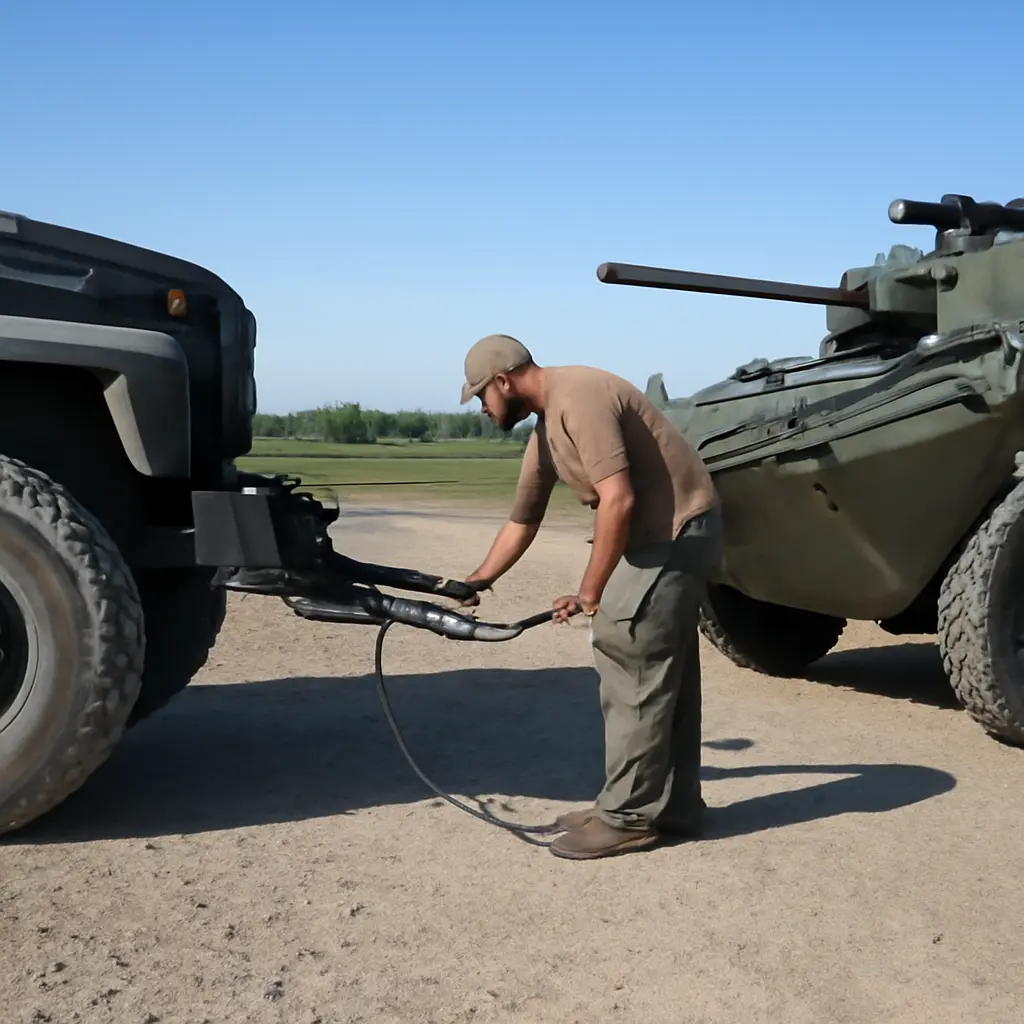
Armored-vehicle recovery is the planned process of moving a disabled, immobilized, or damaged armored vehicle to a safer location or repair point. For beginners, the essential rule is that recovery is a controlled engineering task—not simply a matter of attaching a stronger vehicle and pulling. Operators should follow their vehicle’s approved recovery instructions, assess hazards and ground conditions, use correctly rated equipment, communicate clearly, and stop when the load or situation is uncertain. These principles matter because armored vehicles can weigh tens of tonnes, while a wrong attachment point, unstable vehicle, or failed rigging can cause fatal injuries and major equipment damage.
Recovery planning and armored-vehicle risk
Recovery is the coordinated use of people, equipment, and procedures to restore mobility or relocate a vehicle that cannot move under its own power. The U.S. Army’s recovery doctrine treats recovery as a mission that requires assessment, planning, suitable assets, and risk controls. The exact method depends on the vehicle, its condition, the terrain, and the recovery equipment; there is no universally safe rigging arrangement.
The scale of the challenge is clear from vehicle specifications. The U.S. Army describes the M1A2 Abrams as weighing about 70 tons, while the M88A2 Hercules recovery vehicle is designed to support recovery operations involving heavy tracked vehicles. These figures illustrate why operators must not estimate loads by eye or assume that a cable, tow bar, anchor, or recovery vehicle is adequate. Actual gross weight, configuration, attachments, slope, resistance, and equipment condition all affect the forces involved.
Recovery, towing, and winching are different tasks
Recovery is the broad category: it may include self-recovery, assisted towing, winching, lifting, or preparing a vehicle for evacuation. Towing moves a vehicle with another vehicle through an approved connection. Winching uses a powered line to draw a load, usually toward an anchor or recovery asset. These methods are not interchangeable; a vehicle that is rolling freely on firm ground presents different risks from one that is bogged down, damaged, on a slope, or partly submerged.
Risk assessment before equipment is attached
A recovery leader should first establish what is known and what remains uncertain: vehicle identity and approximate configuration, whether it is occupied, the apparent cause of immobilization, ground stability, slope, overhead or underground hazards, fire or ammunition concerns, and the route to a safe destination. If the vehicle is damaged, leaking, unstable, or potentially hazardous, the plan should account for those conditions before personnel approach or apply force. U.S. Army safety publications emphasize hazard identification and controlled work practices; the same logic applies to recovery, where stored energy and sudden movement can create severe danger.
Once the situation is understood, the next question is whether the connection points and equipment are approved for that specific vehicle and operation.
Equipment ratings and connection points
Recovery equipment is the set of approved components used to connect, move, restrain, or support a vehicle. This can include tow bars, cables, synthetic or wire-rope lines, shackles, connectors, winches, anchors, and recovery vehicles. The U.S. Army’s technical manuals provide vehicle-specific procedures and limitations; operators should use the current manual and unit instructions rather than general advice or improvised arrangements.
Working load limits and equipment inspection
A working load limit (WLL) is the maximum load an item is designed to handle under stated conditions; it is not a guarantee that the item will remain safe in every configuration. Capacity can be affected by wear, corrosion, cuts, kinks, heat, shock loading, sharp bends, side loading, or incompatible hardware. Before use, inspect the full system—not just the main line—including end fittings, pins, hooks, winch components, and attachment points. Remove questionable equipment from service and refer to the manufacturer’s criteria and applicable technical guidance.
Vehicle recovery points and load paths
A recovery point is a designated vehicle attachment intended for a specified recovery use. A load path is the route through which force travels from the recovery asset, through the rigging and connection, into the vehicle structure and ground. Use only points identified for the intended operation in the vehicle’s manual. Do not substitute lifting eyes, transport tie-downs, suspension parts, or convenient-looking structure unless the technical documentation explicitly authorizes it. Misidentification can lead to structural failure or a sudden release of tension.
Rigging configuration and force multipliers
Rigging configuration describes how lines and connectors are arranged, including their direction, angles, and number of loaded parts. In a bridle or multi-leg arrangement, unequal angles can cause one leg to carry substantially more load than another. A pulley or snatch block can change the direction of a line and may alter the force on the anchor and connectors. Therefore, never assume that adding a second line or pulley automatically makes a recovery safer. Use configurations specified by trained personnel and technical references, with every component rated for the actual arrangement.
After confirming the equipment and load path, operators must also account for the environment: terrain can dramatically change the force required and the stability of both vehicles.
Terrain, vehicle condition, and recovery methods
Terrain assessment is the evaluation of the surface, slope, traction, obstacles, and anchoring conditions that affect a recovery. Mud, snow, sand, soft shoulders, steep grades, water, and debris can increase resistance or undermine a recovery vehicle’s footing. The U.S. Army’s field manuals on vehicle operations and recovery stress matching the recovery method to conditions and equipment capability; a method suitable on firm, level ground may be unsafe on a slope or in soft soil.
Self-recovery and assisted recovery
Self-recovery uses the disabled vehicle’s own approved systems or carried equipment to regain mobility. Assisted recovery uses another vehicle or external equipment. Before choosing between them, operators should consider whether the vehicle can safely operate its recovery systems, whether the crew can remain protected, and whether the supporting asset has adequate capacity and traction. If the vehicle is damaged or its condition is uncertain, an approved external recovery plan may be necessary.
Towing a disabled armored vehicle
Towing is appropriate only when the vehicle’s manual permits the configuration and the disabled vehicle can be moved without causing further damage or loss of control. The crew should confirm the approved tow points, required preparation, communication method, route, and any restrictions on speed or distance from the applicable technical publication. A tow connection is not automatically suitable for extracting a deeply bogged vehicle or overcoming a large obstacle.
Winching and anchor stability
Winching is a controlled pull using a powered line. Its safety depends on more than winch capacity: the anchor, line, connectors, vehicle attachment, terrain, and direction of pull must all be suitable. An anchor can fail or move even when the winch itself is within its rating. Operators should avoid shock loading, keep personnel away from loaded lines and potential recoil paths, and use only the procedures and protective measures specified by their equipment instructions and unit training.
Because every recovery creates a changing load, safe operation depends on a clear command structure and communications that allow the team to stop immediately.
Crew roles, communication, and exclusion zones
A recovery team is the group responsible for directing, conducting, and monitoring the operation. At minimum, everyone should know who is in charge, who operates the recovery vehicle or winch, who monitors the connection and vehicle movement, and how to signal an immediate stop. Teams should use their established hand signals or radio procedures, maintain communication throughout the operation, and avoid relying on gestures that cannot be seen from the operator’s position.
Exclusion zones and line-of-fire hazards
An exclusion zone is a controlled area where unnecessary personnel are kept clear of the recovery. Tensioned lines, connectors, and vehicle components can move violently if a system fails or shifts. Personnel should stay out of the line of pull and other identified danger areas, and nobody should step over or handle a loaded line. The exact safe distances and protective measures depend on the equipment, configuration, and governing procedures; use the distances specified in current manuals and training rather than a guessed rule of thumb.
Stop-work authority and controlled movement
Stop-work authority means any team member can call an immediate halt when communication is lost, equipment shifts, a connection behaves unexpectedly, people enter the hazard area, or conditions change. The operator should not resume until the team has re-established control and the leader has reassessed the plan. This is especially important where noise, poor visibility, radio interference, or restricted sightlines make it difficult to judge movement.
A disciplined team also plans for what happens after the vehicle moves: the recovery is not complete until the vehicle is stable, the load is released safely, and equipment is accounted for.
Recovery completion, inspection, and lessons learned
Recovery completion includes securing the vehicle, confirming personnel are safe, releasing tension in a controlled manner, and inspecting the equipment and vehicle for damage. A vehicle that has been recovered may still be unsafe to operate. It should be assessed by qualified maintainers, especially if it has suffered impact, water exposure, track or suspension damage, fluid leakage, or a heavily loaded pull.
Post-recovery inspection and reporting
After the operation, inspect lines, connectors, winches, anchors, and vehicle attachment points according to their technical instructions. Record defects and remove damaged equipment from service. Document the conditions, equipment used, unexpected problems, and final vehicle status through the unit’s reporting process. This information helps maintenance personnel identify hidden damage and helps commanders improve future planning.
Training and realistic practice
Recovery competence comes from formal instruction, supervised practice, and familiarity with the exact vehicle and equipment—not from memorizing a generic checklist. The U.S. Army’s training doctrine emphasizes rehearsals and task proficiency, while vehicle technical manuals supply platform-specific limits. Beginners should practice only in controlled conditions under qualified supervision and should consult the current operator and maintenance publications before any real recovery.
Conclusion: a beginner’s priorities for armored-vehicle recovery
Safe armored-vehicle recovery begins with planning, accurate identification of the vehicle and hazards, approved equipment and connection points, and a realistic assessment of terrain and load. The team must communicate clearly, maintain exclusion zones, use stop-work authority, and inspect the vehicle and equipment after movement. Heavy vehicle weights make guesswork especially dangerous: consult the current technical manual, use trained recovery personnel, and do not improvise a procedure when the correct limits or conditions are unknown. For further learning, study the vehicle-specific recovery publication and your organization’s approved safety and recovery training materials.
Sources: U.S. Army, ATP 4-31, Recovery and Battle Damage Assessment and Repair, https://armypubs.army.mil/; U.S. Army, TM 9-2350-388-10, Operator’s Manual for M88A2 Heavy Equipment Recovery Combat Utility Lift and Evacuation System (HERCULES), https://armypubs.army.mil/; U.S. Army, M1 Abrams Main Battle Tank fact file, https://www.army.mil/article/; U.S. Army, M88A2 Hercules fact file, https://www.army.mil/article/; U.S. Army Combat Readiness Center, Safety and occupational health resources, https://safety.army.mil/.